
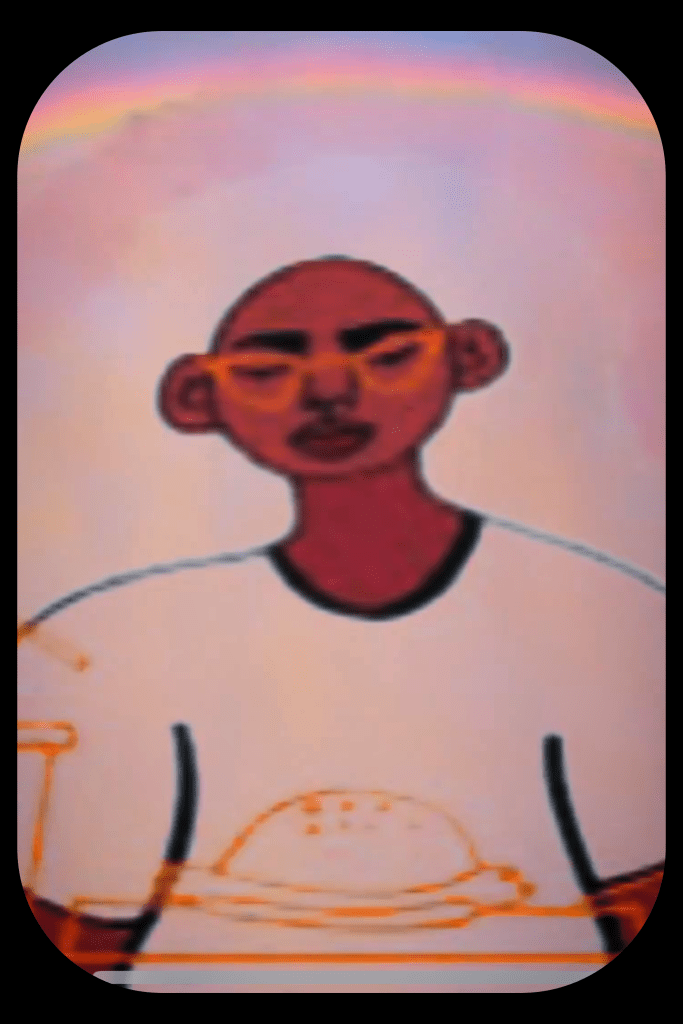
Morgan slumped into the back corner of the campus café, where the hum of chatter and the burnt espresso smell filled the air. She squeezed into the booth, tugging her hoodie to hide the stomach she’d spent the morning avoiding in the mirror.
The faint glow of her laptop reflected her tired eyes as she opened a blank Word document titled Critical Perspectives in Cultural Studies. The assignment was due in three days—a personal reflection on how identity shapes one’s experience within the structures of capitalism. But Morgan couldn’t bring herself to start. The pressure weighed on her, pulling her deeper into her seat.
It wasn’t just the essay—it was everything: The constant feeling of not fitting in, being trans in a world that tried to fit people into boxes, being fat in a culture obsessed with thinness, being a person of color at a predominantly white university. Behind it all, capitalism, systemic racism, and patriarchy ground away at any self-worth she could muster.
Morgan sipped her iced mocha—extra whipped cream, because why not?—and stared at the blank page. The thoughts swirled in her head, but every time she tried to write them down, the words slipped away.
“Hey,” a voice interrupted.
It was Sam from gender studies, sliding into the seat across from her. Sam was thin, white, and had the kind of privilege Morgan could never stop thinking about. Sam’s allyship was appreciated, though it sometimes felt performative.
“Hey,” Morgan muttered, pulling her laptop closer.
“How’s the essay coming along?” Sam asked.
Morgan sighed, closing her laptop halfway. “It’s not. I mean, it’s hard to explain. I feel like… everything’s so much. Like, I can’t even think about my own body without thinking about the systems that made it this way.”
Sam tilted her head. “What do you mean?”
Morgan’s frustration bubbled up. “I mean, how can I talk about capitalism and identity when my whole existence is shaped by it? I’m fat because capitalism pushes cheap, processed food. Systemic racism means I’m stressed all the time, and that stress makes me eat more. Then, patriarchy says I need to be thin to be attractive but masculine to be accepted. It’s a trap. And I can’t win.”
Sam nodded. “Yeah, that’s intense. But… Do you have a job?”
Morgan looked at her. “Yeah. School.”
“No, like a real job. You said you can’t afford better food because of capitalism?”
Morgan clenched her fists. “Exactly. I can’t have a job because school takes all my time. And no one seems to care.”
A silence settled between them. Morgan tapped her fingers on the table, the weight of her words hanging in the air. She hadn’t meant to unload so much, but once she started, she couldn’t stop.
“I don’t mean to be blunt, but… why should anyone care if you don’t?” Sam asked.
Morgan’s blood boiled. Her heart raced while memories of family dinners flashed before her eyes—her parents’ judgment always lurking beneath their concern.
At Thanksgiving, the clatter of silverware had filled the awkward silence. Her mom poked at her salad, while her dad eyed Morgan’s overflowing plate.
“So, how’s school?” her father asked.
Morgan shrugged. “It’s fine. I’m working on an essay about how capitalism and patriarchy shape identity. You know, the things that explain why people like me are stuck.”
Her mother sighed. “And when do you take responsibility for your own choices, Morgan?”
Morgan bristled at the question. “Responsibility? I’m just trying to survive in these systems.”
“Surviving or making excuses?” Her dad’s voice seethed with frustration. “You constantly blame the ‘system’ that you know little about. And capitalism, and patriarchy, but what about your own decisions? Not everything is someone else’s fault.”
Morgan’s face flushed with anger. “You don’t get it. You don’t know what it’s like to be trans, fat, and a person of color.”
“We get more than you think,” her mom said. “But blaming the world won’t change anything. At some point, you have to make changes for yourself.”
Morgan stabbed her food, glancing at both her parents’ Paris Hilton bodies. “You’re just saying that because you’ve always been comfortable while benefiting from systems that keep people like me down.”
Her dad scoffed. “Comfortable? We worked hard for everything we have. That includes you.”
“Yeah, but you’re part of the system—”
“Morgan,” her mother cut in sharply. “We love you, but deflecting is exhausting. When’s the last time you took responsibility for anything in your life?”
The memory burned in Morgan’s mind as she stared at Sam. Her parents hadn’t understood either. Why couldn’t anyone see that it wasn’t her fault?
Sam’s voice broke through. “Maybe there’s another way to look at it. Those systems suck, but don’t you have some agency outside of them?”
Morgan frowned. “You don’t get it. You don’t live it.”
“I’m not saying I do,” Sam said quickly. “I just mean, maybe we can fight the systems without letting them define everything.”
Morgan wanted to argue, but the words faded into the background noise of the café. She opened her laptop again and typed: My body is the battlefield, shaped by forces beyond my control.
It wasn’t much, but it was something. Maybe Sam was right—maybe she had more power than she thought. But for now, it felt safer to believe it wasn’t her fault.
She stared at the screen, fingers hovering over the keys.
The world built this body, and I’m just trying to live in it.
Her parents had grown sick of hearing that. But she wasn’t ready to take responsibility. Not yet.
The dinner with her parents had ended in the same way it always did—her mother silently clearing the plates while her father muttered something under his breath about “taking responsibility.” Morgan had stormed out, their voices still echoing in her mind, and she hadn’t looked back. She found herself at a park. It was her usual escape when the walls felt like they were closing in.
The air was crisp. The sun sunk lower, casting the park in shades of orange and gold. Morgan collapsed onto a bench, clutching her phone. She stared at the blank screen, then opened her laptop and pulled up the essay she’d barely started.
My body is the battlefield, shaped by forces beyond my control.
The words felt true when she’d first typed them, but now they seemed hollow, almost like an excuse. She read the sentence again, this time slower. And then again.
Was it really beyond my control?
Morgan’s mind flashed back to her parents’ sharp and frustrating words at dinner.
“You can’t hide behind theories forever,” her mother had said. Her tone, laced with exhaustion, stuck with Morgan.
They don’t understand, she had told herself at the time. They never will. But now, sitting here alone, the usual righteous anger she felt didn’t come. Instead, there was something else—a tiny, nagging doubt buried under all the noise. She hated herself for it, but it was there:
What if they were right?
Her fingers hovered over the keys, unsure what to type next. She glanced up, watching the people pass by—joggers, couples walking their dogs, kids playing on the swings. For a moment, she let herself wonder: Do they feel trapped like I do? Or are they just… living?
Morgan closed the laptop with a sigh and leaned back, staring at the sky as the colors deepened into twilight. It wasn’t that she didn’t believe in the systems she’d studied—capitalism, patriarchy, racism—those were real, and they shaped everything. But sitting there, alone in the park, the question gnawed at her: What if I have more control than I’ve let myself believe?
Her thoughts drifted back to her conversation with Sam earlier that day. Sam had suggested something that Morgan had brushed off at the time, but now, in the quiet of the park, it resurfaced: Maybe there’s still space for you to have some agency.
She hated that Sam might be right. She hated that her parents might be right too. She hated the feeling of powerlessness that came with blaming everything on systems bigger than herself. And yet… it felt safer that way. It absolved her of responsibility. It made the world easier to understand.
But what if she wasn’t as powerless as she thought?
The wind rustled the leaves overhead, and Morgan stood up, pocketing her phone. She wasn’t ready to change everything. Not yet. But maybe… maybe she could start small. Try again tomorrow. She didn’t have to figure it all out now.
As she began to walk back to her dorm, the thought lingered: Maybe I can start shaping my own life, just a little. It was a terrifying thought, but for the first time in a long time, it didn’t feel completely impossible.
My body is the battlefield, she thought again. But maybe, just maybe, I can start shaping it, too.
With that, Morgan walked into the dusk, the flicker of possibility faint but present, like the last light of the setting sun.

 Allevi8ed Writing
Leave a comment